
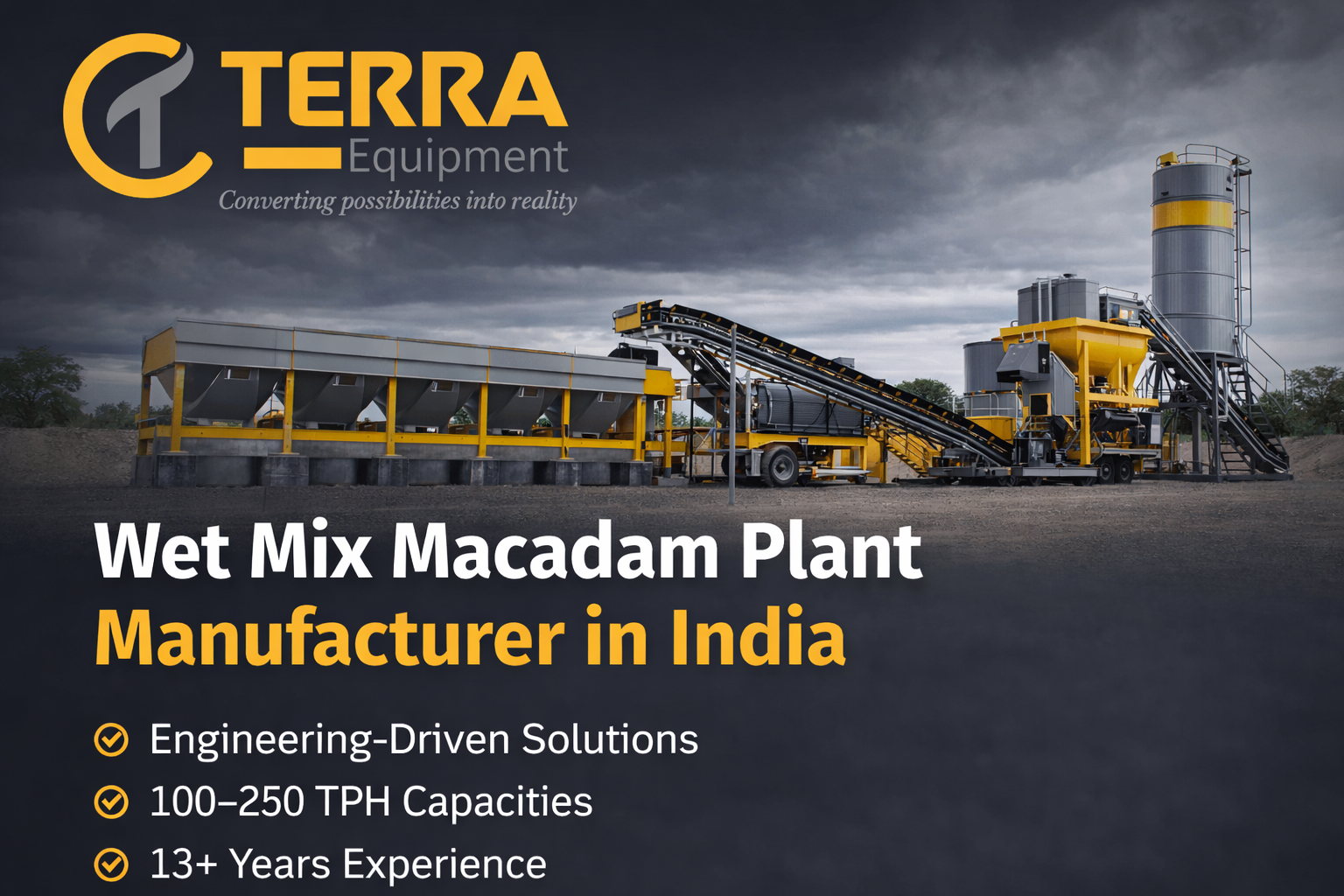
Wet Mix Macadam Plant
Manufacturer in India
Wet Mix Macadam Plant in India
Wet Mix Macadam Plant in India plays a vital role in modern road construction and infrastructure development. With increasing investments in highways, expressways, industrial corridors, and rural connectivity, the demand for reliable wet mix plants has grown steadily. A Wet Mix Macadam (WMM) plant is designed to produce a homogeneous blend of aggregates and water in precise proportions, forming the base and sub-base layers of roads. Consistent mixing, controlled moisture levels, and stable output capacity are essential for durable pavement construction.
Within India's infrastructure landscape, contractors and civil engineering firms require equipment capable of operating efficiently across diverse climatic and site conditions. A well-engineered WMM plant ensures uniform gradation, high productivity, and minimal downtime, making it an indispensable component of road construction projects.
About Terra Equipment
Terra Equipment provides technologically advanced machinery for the civil and road construction industry. With over 13 years of experience in product design, development, and on-field implementation, the company operates from Mehsana, Gujarat. Its approach centers on engineering-driven manufacturing and field-tested solutions tailored to infrastructure projects across India.
Understanding the Wet Mix Macadam Plant
A Wet Mix Macadam plant is engineered to combine aggregates with water to produce a consistent wet mix used in road base construction. The system ensures accurate proportioning through multiple feeder bins and controlled water addition within a high-performance mixing unit. The finished material is then conveyed for storage or directly loaded into trucks for transport to the paving site.
Compared to conventional manual mixing, a modern WMM plant offers automated control, uniform blending, and consistent throughput. Designed for continuous operation, it is well-suited for large-scale infrastructure projects where quality control and productivity are critical.
Models Available for Different Project Capacities
Terra Equipment offers multiple capacity configurations to meet varying project demands. These options allow contractors to select plant capacity based on project scale, material requirements, and operational planning. Higher-capacity models are typically deployed in national highways and major infrastructure corridors, while mid-range capacities are commonly used for urban and district-level road construction.
- WMM – 100 TPH Urban & district-level road construction
- WMM – 150 TPH Mid-range infrastructure projects
- WMM – 200 TPH State highways & large corridors
- WMM – 250 TPH National highways & major infrastructure corridors
Standard Components of Wet Mix Macadam Plant
The wet mix plant incorporates key components to ensure structured material flow and uniform output. Each component is engineered for synchronized material handling and operational stability. The modular configuration supports ease of maintenance and consistent site performance.
- Cold feeder bins
- Charging conveyor
- Mixing unit
- Water tank
- Cement silo and screw conveyor (optional)
- Load out conveyor
- Storage hopper or storage silo
- Automatic control panel
Engineering Design of the Mixing Unit
The mixing unit forms the core of the Wet Mix Macadam Plant. Terra Equipment integrates a pug mill unit with six shafts to enhance torque absorption and maintain stable performance. The shafts are designed with approximately five inches of thickness, contributing to structural strength and extended service life.
Unlike slotted shaft designs, this configuration maintains full structural thickness. Arms and tips are fitted with distance pieces to improve durability, while their alternate arrangement promotes homogeneous mixing and uniform aggregate blending. Fast-replaceable liners, arms, and tips help reduce maintenance downtime and simplify servicing.
This engineering approach supports consistent output quality and long-term mechanical reliability, particularly in demanding road construction environments.
Technical Overview of WMM Plant Models
The WMM 100 TPH model includes four aggregate bins with a 52-ton storage capacity, auxiliary drive motors of 2 HP each, and a 25 HP main drive motor for the pug mill. It features a 10,000-liter water tank with a 2 HP monoblock pump and a 2-ton storage hopper.
The WMM 150 TPH model also includes four bins with 52-ton capacity, an extended auxiliary conveyor length, and a 30 HP main drive motor. The storage hopper capacity increases to 5 tons, while maintaining the same 10,000-liter water tank configuration.
The WMM 200 TPH model is equipped with four bins offering 68-ton storage capacity, higher auxiliary drive power, and a 40 HP main drive motor. The storage hopper capacity extends to 10 tons to support higher output requirements.
All models are equipped with an oversize removal screen featuring 65 mm x 65 mm wire mesh, a slinger conveyor, load out conveyor, hydraulic power pack, and an automatic control panel for structured plant management.
Applications in Road Construction Projects
Wet Mix Macadam plants are widely used in infrastructure projects. The uniform wet mix produced by the plant forms a stable foundation layer, contributing to long-term pavement performance.
- Highway construction
- State and district roads
- Rural road connectivity
- Industrial corridors
- Airport pavement base layers
- Urban road redevelopment
Operational Workflow of a WMM Plant
The process within a Wet Mix Macadam Plant follows a structured sequence. This systematic workflow ensures consistent gradation and moisture control, which are essential for road base stability.
Advantages of Automated Control System
The automatic control panel plays a key role in maintaining operational precision. It enables monitoring of feed rate, water flow, and overall plant performance, reducing manual intervention and improving output consistency.
Controlled mixing minimizes material wastage and supports compliance with infrastructure quality standards. In large-scale projects, accurate process control contributes to improved compaction and structural performance at the construction site.
Wet Mix Macadam Plant Demand in India
India's infrastructure expansion, including highway development and urban connectivity initiatives, continues to drive demand for high-capacity road construction equipment. A Wet Mix Macadam Plant in India must withstand intensive production cycles, variable aggregate quality, and extended operational hours.
Manufacturers focus on durability, ease of maintenance, and adaptability to diverse site conditions. Multiple capacity options enable contractors to align equipment selection with project scope and logistical planning.
How to Select the Right WMM Plant Capacity
When selecting a Wet Mix Macadam Plant, contractors typically consider the following factors. Choosing the appropriate capacity ensures optimized productivity without straining operational resources.
- Required daily output
- Project timeline
- Available site space
- Aggregate supply logistics
- Power availability
- Transportation planning
Routine maintenance is essential for long-term plant efficiency. Regular inspection of liners, arms, shafts, conveyor belts, and hydraulic components helps prevent unexpected breakdowns. The availability of fast-replaceable parts reduces downtime and supports continuous production during peak construction phases. Structured maintenance planning enhances operational reliability, particularly in remote or large-scale project locations.