
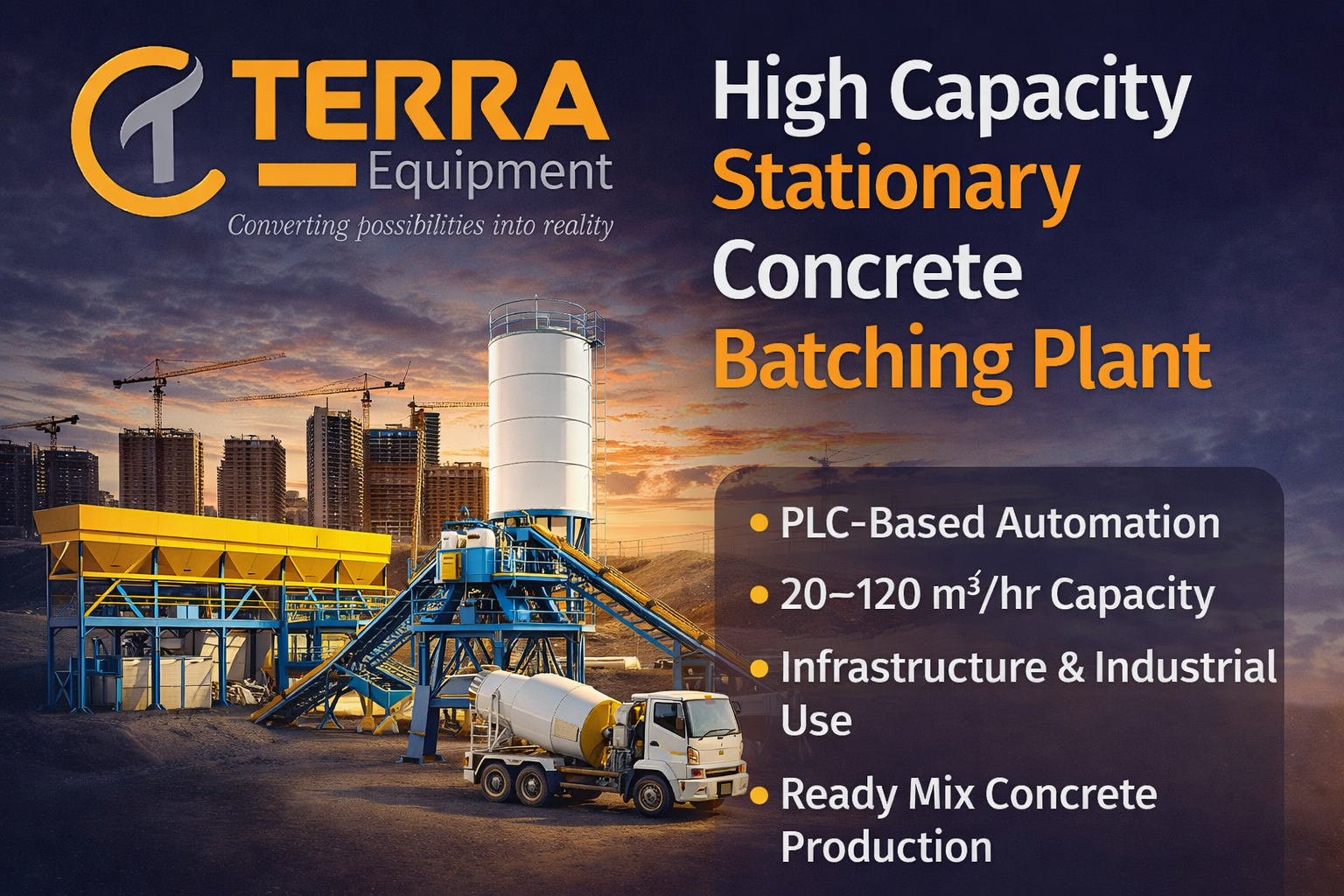
High Capacity Stationary Concrete Batching Plant
High Capacity Stationary Concrete Batching Plant
In modern construction and infrastructure development, the need for consistent, high-quality concrete production has become essential. A high capacity stationary concrete batching plant is designed to meet this demand by delivering precise, continuous, and large-scale concrete output. These plants are widely used in projects where reliability, accuracy, and efficiency are critical for maintaining construction timelines and ensuring structural integrity.
A stationary batching plant operates from a fixed location, making it suitable for long-term projects such as highways, bridges, dams, and large commercial developments. Its design emphasizes stability, high production capacity, and automation, enabling uninterrupted operations with minimal manual intervention. As construction demands continue to grow, these plants play a vital role in maintaining productivity and quality control across various applications.
Understanding High Capacity Stationary Concrete Batching Plant Systems
A high capacity stationary concrete batching plant is an integrated system that combines multiple components to produce concrete in a controlled and efficient manner. It manages the storage, weighing, mixing, and discharge of raw materials such as cement, aggregates, water, and admixtures.
The plant operates through a PLC-based control system that automates the entire batching process. This ensures accurate measurement of materials and consistent mixing results. Designed for high-volume production, the system supports continuous concrete supply without compromising on quality.
Advanced mixing units such as pan mixers, twin shaft mixers, and planetary mixers improve the uniformity of the concrete mix. Each mixer type can be selected based on specific project requirements, providing flexibility in operation and performance.
Key Components of a Stationary Concrete Batching Plant
A stationary concrete batching plant includes several essential components that work together to ensure efficient and reliable production:
- Material Storage System: Includes aggregate bins and cement silos designed for bulk storage and smooth material handling
- Weighing System: Digital load cell-based system for accurate measurement of cement, water, aggregates, and additives
- Mixing Unit: High-performance mixers that ensure uniform and consistent concrete output
- Feeding System: Inclined belt conveyor or skip bucket system for efficient material transfer
- Control Panel: PLC-based system with a user-friendly touch screen interface for automated operation
- Admixture Dosing System: Enables precise addition of chemical additives
- Discharge System: Provides sufficient height clearance for easy unloading into transit mixers
Each component is engineered to support high-capacity production while maintaining operational efficiency and consistency.
Working Process of High Capacity Stationary Batching Plants
The working process of a stationary batching plant follows a structured and automated sequence to ensure precision and efficiency:
- Raw materials such as aggregates, cement, and additives are stored in designated compartments
- Materials are accurately weighed using load cell systems
- The measured materials are transferred to the mixer through conveyors or skip buckets
- Water and admixtures are added according to the required mix design
- The mixer blends all materials to produce uniform concrete
- The finished concrete is discharged into transit mixers for transportation
This automated workflow reduces manual errors and ensures consistent output, which is essential for large-scale construction projects.
Salient Features of High Capacity Stationary Concrete Batching Plants
A high capacity stationary concrete batching plant is equipped with advanced features that enhance performance and usability. These features contribute to improved efficiency, simplified operation, and reliable production.
- Fully automatic control system with a user-friendly touch screen interface
- High storage capacity for aggregates and raw materials
- Flexible mixer options including pan, twin shaft, and planetary mixers
- Accurate weighing system using digital load cells
- Efficient material feeding through conveyor or skip systems
- Adequate discharge height for smooth loading operations
- Simple operation with low maintenance requirements
- Customization options to suit specific project needs
- Continuous operation capability for large-scale production
These features make the plant suitable for demanding construction environments where precision and efficiency are essential.
Technical Capabilities and Production Range
High capacity stationary batching plants are available in various configurations to meet different project requirements. The production capacity typically ranges from 20 cubic meters per hour to 120 cubic meters per hour, offering flexibility for varying construction demands.
The system is equipped with high-performance motors and reduction gearboxes to ensure smooth and reliable operation. Advanced control systems and a robust structural design contribute to long-term durability and consistent output. The integration of automation further helps maintain uniform quality across all batches.
The modular design allows for easy expansion and scalability, enabling upgrades based on future project needs.
Applications of Stationary Concrete Batching Plants
High capacity stationary concrete batching plants are widely used across multiple sectors of the construction industry. Their ability to deliver consistent, high-volume concrete makes them suitable for a wide range of applications:
- Ready mix concrete production for commercial supply
- Infrastructure projects such as highways and bridges
- Dam construction and large-scale water management projects
- Industrial construction and heavy engineering works
- Urban development and high-rise building projects
- Road construction and paving operations
These plants are ideal for projects that require continuous and reliable concrete supply over extended periods.
Advantages of Using High Capacity Stationary Concrete Batching Plants
The use of a stationary batching plant offers several operational and technical advantages that enhance overall project efficiency:
- Consistent concrete quality through precise material control
- High production capacity for large-scale construction projects
- Reduced manual intervention due to advanced automation
- Improved operational efficiency and productivity
- Lower maintenance requirements with a simplified design
- Enhanced safety through controlled and enclosed systems
- Flexibility to customize based on specific project requirements
These advantages make stationary batching plants a preferred choice for contractors and infrastructure developers.
Importance in Modern Construction Industry
In today's construction environment, maintaining quality and efficiency is critical for project success. High capacity stationary concrete batching plants play an important role in achieving these objectives by providing a reliable and consistent source of ready mix concrete.
The ability to produce large volumes of concrete with uniform quality ensures that construction timelines are maintained without delays. These plants also support better resource management by reducing material wastage and optimizing production processes.
With increasing demand for infrastructure development, the importance of automated and high-capacity batching plants continues to grow, making them an essential part of modern construction practices.
Customization and Operational Flexibility
One of the key strengths of a high capacity stationary concrete batching plant is its adaptability to different project requirements. The plant can be customized with various optional accessories and configurations to enhance performance.
Optional features may include advanced control systems, additional storage units, moisture control systems, and temperature management solutions. These enhancements enable efficient operation under varying environmental conditions and project demands.
The modular design also allows easy upgrades and modifications, ensuring long-term usability and operational flexibility.
Maintenance and Operational Considerations
Maintaining a stationary concrete batching plant involves regular inspection and servicing of key components to ensure smooth and reliable operation. Automated systems reduce the need for manual intervention, simplifying maintenance procedures.
Proper calibration of weighing systems, timely lubrication of moving parts, and routine inspection of electrical components help maintain optimal performance. The straightforward design allows easy access to components, reducing downtime during maintenance.
Efficient maintenance practices contribute to extended equipment life and consistent production output.