
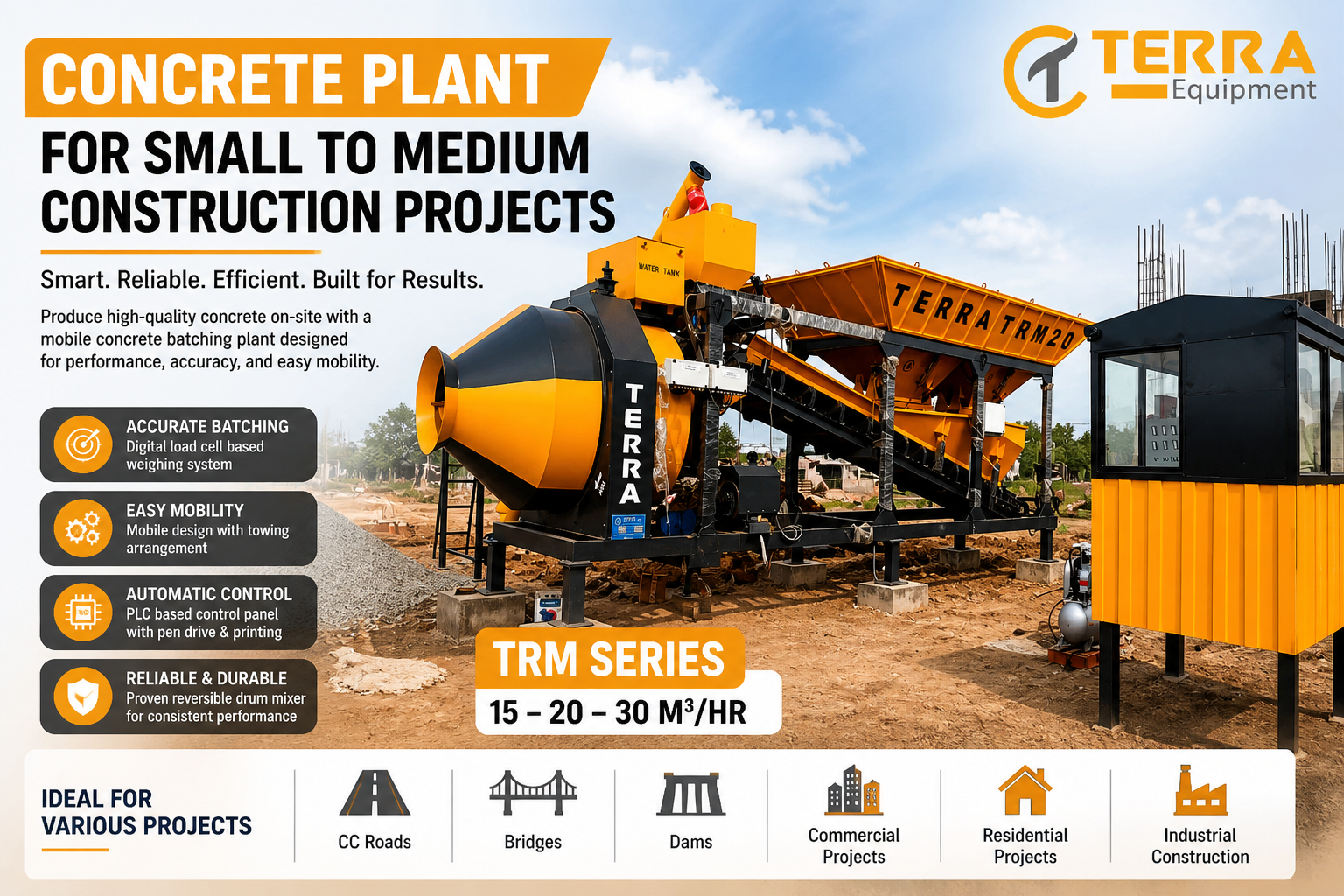
Concrete Plant for Small to Medium Construction Projects
A concrete plant for small to medium construction projects plays an important role in improving on-site concrete production where consistent quality, controlled batching, and practical mobility are required. In many construction jobs, depending completely on outside ready-mix supply can lead to delays, especially when the site is located far from a batching source or when concrete is needed in controlled quantities throughout the day. For contractors, builders, civil engineers, and infrastructure companies, a compact concrete plant helps manage production more efficiently without relying on frequent external deliveries.
Small and medium construction projects often include residential buildings, commercial structures, internal roads, industrial flooring, bridges, canal works, and concrete road development. These projects may not require a large stationary batching plant, but they still need accurate mixing, proper material proportioning, and dependable output. A mobile concrete batching plant with a reversible drum mixer is a practical solution because it supports site-based concrete production with lower operating complexity.
Terra Equipment manufactures construction and road equipment, including mobile concrete batching plants with reversible drum-type mixers. The TRM Series is designed with output capacities such as 15 m³/hr, 20 m³/hr, and 30 m³/hr, making it suitable for different project scales. The system includes features such as load cell-based weighing, PLC control, aggregate storage bins, timer-based water feeding, and a mobility arrangement for easy movement between job sites.
Why Small and Medium Projects Need a Dedicated Concrete Plant
Construction projects require concrete at different stages, and timing often directly affects work quality. If concrete arrives late or if batch consistency changes from one delivery to another, the project may face quality issues, surface defects, wastage, or delays. A dedicated concrete plant helps address these challenges by allowing the project team to produce concrete closer to the point of use.
For small and medium construction sites, the main requirement is not only production capacity but also flexibility. Many projects need concrete in controlled quantities for foundations, slabs, columns, roads, pathways, drains, boundary walls, and structural elements. A compact or mobile concrete batching plant can manage these needs without occupying excessive site space.
Another major advantage is better control over material usage. Cement, aggregates, water, and additives must be measured properly to maintain concrete strength and workability. When batching is done manually, accuracy can vary from batch to batch. A plant with digital weighing and automated control reduces this variation and supports more predictable concrete output.
Mobile Concrete Batching Plant with Reversible Drum Mixer
A mobile concrete batching plant with a reversible drum mixer is widely used where easy installation, shifting, and low operating effort are important. In this type of system, the drum rotates in one direction for mixing and in the reverse direction for concrete discharge. This simple working mechanism makes the system easier to operate and maintain at construction sites.
The reversible drum-type mixing unit is valued because it delivers consistent mixing while keeping operation straightforward. For project teams that need reliable concrete production but do not want a large and complex plant setup, this type of machine offers a practical balance between performance and usability.
The mobile arrangement is also helpful when a contractor works across multiple sites. Instead of creating permanent infrastructure at every location, the plant can be shifted according to project requirements. This is especially useful for road work, bridge work, canal construction, rural infrastructure, industrial foundations, and commercial site development.
How a Concrete Plant Improves Site Productivity
A concrete plant improves productivity by reducing waiting time and allowing better coordination between batching, transport, placement, and finishing. On many sites, labour and equipment are ready, but work slows down because concrete is not available at the right time. Site-based batching reduces this dependency and helps maintain steady progress.
When concrete is produced near the work area, contractors can plan batches according to actual site progress. This reduces unnecessary wastage and supports a smoother workflow. It also helps the team maintain better control over concrete freshness, which is important for placement, compaction, and finishing quality.
For small and medium projects, productivity is often affected by space limitations, changing work schedules, and material movement. A mobile plant helps manage these challenges because it can be installed in a suitable site area and operated as per project demand.
Key Benefits of Concrete Plant for Small to Medium Construction Projects
- Better control over concrete quality and batching accuracy
- Suitable output capacity for small and medium project demands
- Reduced dependency on outside ready-mix concrete supply
- Improved concrete availability during active site work
- Easier site movement with mobile plant arrangement
- Lower material wastage through controlled production
- Useful for roads, buildings, bridges, commercial projects, and infrastructure work
- Simplified operation with PLC-based control systems
- Consistent mixing through reversible drum technology
- Practical solution for contractors handling multiple project locations
Important Features to Check Before Selecting a Concrete Plant
- Output capacity suitable for daily concrete demand
- Accurate cement and aggregate weighing system
- Reliable mixing and discharge mechanism
- Easy mobility and towing arrangement
- PLC-based control panel for automatic operation
- Accurate water and additive feeding system
- Suitable aggregate bin storage capacity
- Power requirement and DG set compatibility
- Ease of maintenance at the site
- Availability of after-sales service and spare support
Applications of Concrete Plants in Construction Projects
- Residential construction projects
- Commercial building sites
- CC road development
- Bridge and culvert work
- Dam and canal construction
- Industrial floor construction
- Rural road and infrastructure work
- Boundary wall and foundation work
- Site-based ready-mix concrete production
- Medium-scale contractor projects
Role of Automation in Concrete Batching
Automation is an important factor in modern concrete batching. A fully automatic PLC-based control panel helps reduce manual errors and improves repeatability in batching. When cement and aggregates are weighed using digital load cells, the mix becomes more accurate compared to manual measurement. Timer-based water feeding also supports better control over concrete consistency. Water quantity has a direct effect on strength, workability, and setting behaviour. Controlled feeding helps maintain more reliable results.
Why Mobility Matters in Medium Construction Projects
Mobility is an important advantage for contractors who work on different sites or changing project locations. A mobile concrete batching plant can be shifted as required, which reduces the need for permanent civil foundation work. This is helpful when the project duration is limited or when the site layout keeps changing. Road projects, canal projects, bridges, and remote construction sites often require equipment that can be moved closer to the working zone.
Concrete Quality and Site Control
Concrete quality depends on proper proportioning, mixing time, water control, material quality, and handling. A concrete plant helps manage these factors in a structured way. When aggregates, cement, water, and additives are fed through controlled systems, the chances of inconsistent concrete are reduced. In small projects, manual mixing may seem convenient, but it can lead to uneven batches. In medium projects, inconsistent batching can create larger problems because bigger quantities are involved.
Concrete Plant for Contractors and Builders
Contractors and builders need equipment that supports timelines, quality, and practical site operation. A concrete plant for small to medium construction projects helps reduce delays and improve work planning. It also gives better control over concrete production compared to depending completely on third-party supply. For builders working on residential and commercial projects, the plant supports consistent concrete production for slabs, columns, beams, and flooring.
Maintenance and Operational Considerations
A concrete plant should be easy to maintain because construction sites often operate under demanding conditions. Dust, cement, aggregates, and continuous operation can affect machine performance if maintenance is ignored. Regular cleaning, inspection, lubrication, and checking of weighing systems are important for long-term reliability. Operators should also monitor the drum, conveyor, bins, water system, control panel, and pneumatic components.
FAQs
Conclusion
A concrete plant for small to medium construction projects is a practical solution for contractors, builders, and civil project teams that need reliable concrete production at the site. It helps improve batching accuracy, reduce waiting time, control material usage, and maintain a better workflow during construction. Mobile concrete batching plants with reversible drum mixers are especially useful because they combine mobility, simple operation, and consistent mixing.