Concrete Mixing System
A concrete mixing system is an essential part of modern construction where concrete must be prepared with accuracy, consistency, and controlled quality. Whether the project involves roads, bridges, dams, commercial buildings, residential construction, or infrastructure development, the quality of concrete preparation directly affects the strength, workability, and long-term performance of the structure. A well-designed concrete mixing system helps contractors manage material batching, mixing, and discharge in a more organized, reliable, and efficient way.
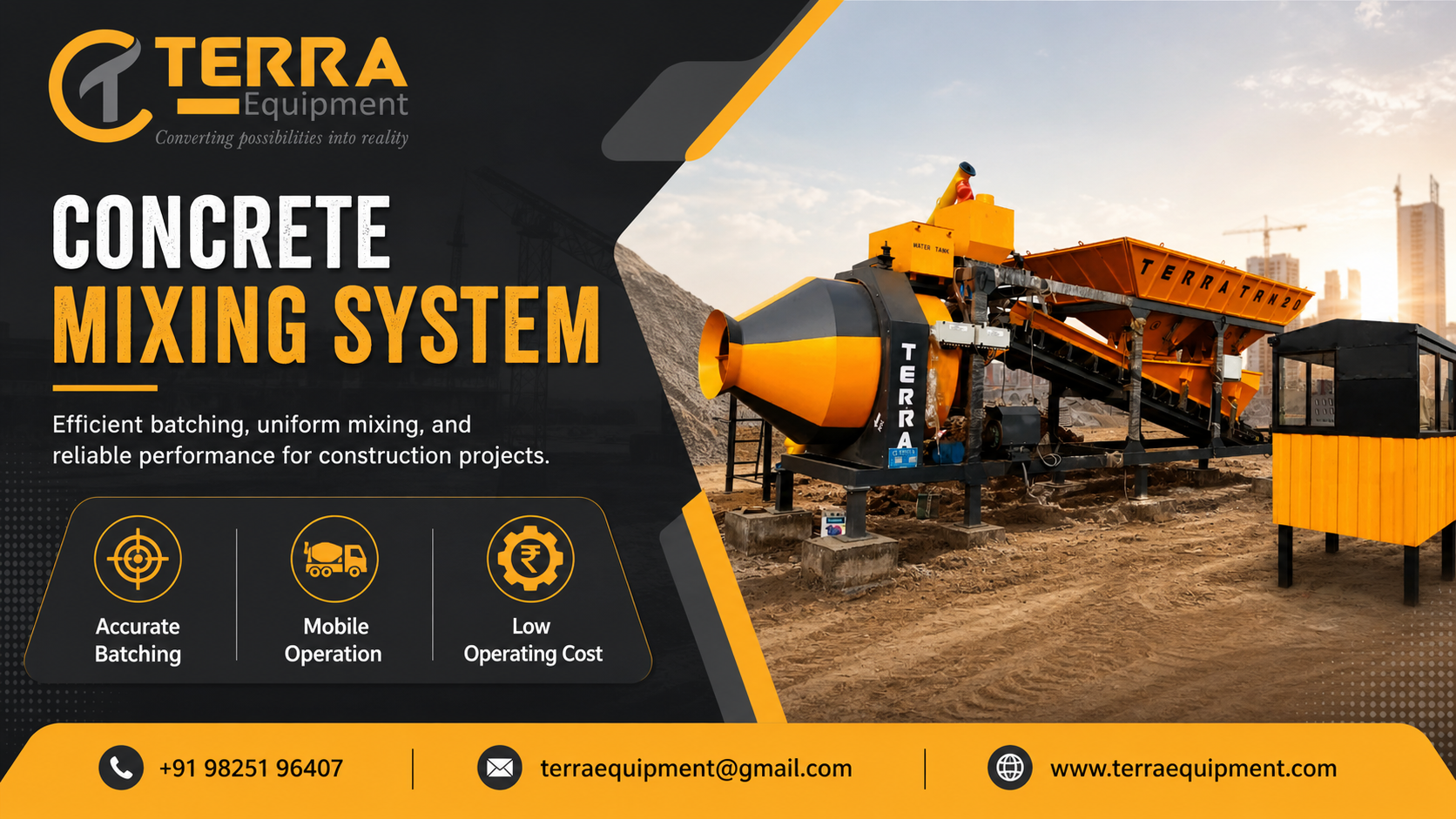
A mobile concrete batching plant with a reversible drum type mixer is especially useful for construction sites that require flexibility and easy movement. This system is designed to produce concrete close to the actual work area, reducing dependency on external concrete supply and improving site productivity. Terra Equipment offers mobile concrete batching plants with reversible drum type mixers under the TRM Series, including model capacities such as TRM 15, TRM 20, and TRM 30. The system is designed for low operating cost, reduced connected power, and practical usability at construction sites.
What Is a Concrete Mixing System?
A concrete mixing system is a complete setup used to store, measure, feed, mix, and discharge concrete ingredients in the correct proportions. These ingredients generally include aggregates, cement, water, and sometimes additives or supplementary materials depending on the project requirement. The main purpose of the system is to produce concrete with uniform quality and controlled mix consistency.
In construction, concrete quality depends on accurate material proportioning and proper mixing. If the mix is not uniform, the final concrete may show lower strength, poor surface finish, cracks, or durability-related issues. A systematic batching and mixing process reduces these problems by maintaining better control over every batch.
A mobile concrete mixing system is designed for projects where the plant needs to be shifted from one site to another. This makes it useful for contractors working across multiple project locations or infrastructure sites where concrete is required at different work points.
How a Mobile Concrete Mixing System Works
A mobile concrete mixing system works through a planned and controlled process. Aggregates are stored in bins, cement is fed through a conveyor system, water is added through a controlled feeding arrangement, and the mixer combines all materials to prepare concrete. After proper mixing, the concrete is discharged for use at the site.
In a reversible drum type mixer, the drum performs both mixing and discharge functions. Forward rotation of the drum mixes the material, while reverse rotation discharges the prepared concrete. This simple working principle makes the system easy to operate and maintain in construction environments.
The TRM Series uses digital load cell based weighing for cement and aggregates, while water and additives are managed through a timer-based accurate discharge system. The plant also includes a fully automatic PLC based control panel with pen drive and printing facility, which supports organized batching and production tracking.
Importance of Concrete Mixing Systems in Construction
Concrete is one of the most widely used construction materials, but its performance depends heavily on how it is prepared. A concrete mixing system ensures that materials are measured correctly and mixed uniformly before placement. This improves concrete reliability and reduces the chances of inconsistent batches.
For construction companies, a dependable mixing system also improves workflow. When concrete is produced at the site according to actual project demand, teams can reduce delays and manage concrete placement more efficiently. This is especially helpful for road work, bridge work, foundation construction, and large civil projects.
Material control is another important factor. Manual or poorly managed mixing can lead to wastage, incorrect proportions, and uneven concrete quality. A batching system with automated controls and accurate weighing helps reduce these issues and supports better site discipline.
Key Features of a Concrete Mixing System
A good concrete mixing system should be practical, accurate, durable, and easy to operate. It should support site productivity while maintaining consistent concrete quality. Important features include:
- Reversible drum type mixing unit for easy mixing and discharge
- Mobile structure with towing arrangement for better site movement
- Digital load cell based weighing system for cement and aggregates
- Timer based water and additive feeding system
- Fully automatic PLC based control panel
- Pen drive and printing facility for batching records
- Cross bin feeder for storing different aggregate sizes
- Low operating cost and reduced connected power requirement
- Easy maintenance and hassle-free operation
- Suitable design for road, bridge, dam, commercial, and residential projects
These features make the system useful for contractors who need dependable concrete production without unnecessary complexity.
Applications of Concrete Mixing Systems
Concrete mixing systems are used across different civil and infrastructure projects. Their application depends on project size, required concrete volume, site conditions, and mobility needs.
- CC road construction
- Bridge construction projects
- Dam and canal-related works
- Commercial building construction
- Residential construction projects
- Industrial foundations and flooring
- Infrastructure development projects
- Ready mix concrete preparation at project sites
- Remote construction sites
- Road construction and paving work
A mobile concrete batching system is especially useful where concrete demand changes from one location to another during the project.
Benefits of Using a Mobile Concrete Mixing System
A mobile concrete mixing system offers practical benefits for contractors and builders. It allows concrete production at or near the project site, which improves control over batching and reduces waiting time. This helps maintain smoother workflow during active construction.
Accurate batching is another major benefit. Digital weighing of materials helps maintain correct proportions, while controlled water feeding supports better concrete consistency. Since water quantity directly affects strength and workability, accurate feeding is important for quality construction.
Mobility is also a key advantage. A mobile plant can be shifted between sites or moved within a large project area. This is useful for road construction, infrastructure development, and projects where concrete work progresses in sections.
The system also supports lower operating cost compared with many larger or more complex plant setups. With reduced connected power and a practical mechanical design, it can be suitable for contractors looking for efficient concrete production at site level.
Why Reversible Drum Type Mixer Is Useful
A reversible drum type mixer is widely used because of its simple and reliable operation. The same drum handles both mixing and discharge by changing the direction of rotation. This makes the machine easier to understand, operate, and maintain.
At construction sites, equipment must work in dusty, rough, and demanding conditions. A system that is easy to clean and maintain can reduce downtime. The reversible drum design supports practical maintenance and can be operated efficiently by trained site teams.
This type of mixer is suitable for different construction applications because it provides uniform mixing and controlled discharge. It is especially helpful for contractors who need reliable concrete output without a complicated mixing arrangement.
Automation in Concrete Mixing Systems
Automation improves the accuracy and repeatability of the concrete production process. A PLC based control panel helps manage batching operations more systematically. It reduces manual dependency and helps operators maintain consistent batching cycles.
Digital load cell weighing improves measurement accuracy for aggregates and cement. This helps maintain better mix proportions from batch to batch. Timer-based water feeding also supports controlled water quantity, which is important for achieving the required concrete workability.
Automation improves not only quality but also documentation. Features such as pen drive and printing facility can help maintain production records, which are useful for project monitoring, quality checks, and batch tracking.
Technical Specifications and Capacity Options
Concrete mixing systems are available in different capacity options based on project requirements. The TRM Series includes models such as TRM 15, TRM 20, and TRM 30. These models provide output capacities of 15 M3/Hr, 20 M3/Hr, and 30 M3/Hr respectively. Material storage capacity ranges from 10 M3 to 14 M3, depending on the model.
The system uses inclined screw conveyor feeding for cement, timer-based accurate water feeding, and a fully automatic PLC based control panel. The concrete discharge height also varies by model, making it suitable for different site arrangements.
Choosing the correct capacity depends on daily concrete demand, project size, working hours, available site space, and future usage. A smaller capacity model may be suitable for moderate site needs, while a higher capacity model can support projects with faster concrete consumption.
Optional Accessories for Better Site Functionality
Optional accessories can improve the usability and control of a concrete mixing system depending on project needs. These may include a prefab cabin for the control panel, fly ash or GGBS feeding system, storage silos, and SCADA software with computer.
A control cabin helps protect the control panel and operator from dust and weather conditions. Storage silos support better cement or material handling. SCADA software can improve monitoring and control where advanced batching management is required.
These accessories are useful for contractors who want better automation, cleaner site organization, and improved production tracking.
Buyer Checklist for Selecting a Concrete Mixing System
Before selecting a concrete mixing system, buyers should evaluate actual site needs instead of choosing only by machine capacity. A practical selection process helps avoid underuse, overloading, or operational mismatch.
- Required concrete output per hour
- Type of construction project
- Need for mobility and towing arrangement
- Aggregate storage capacity
- Cement feeding method
- Water feeding accuracy
- Type of mixer used
- Automation and control panel features
- Power requirement and DG set suitability
- Concrete discharge height
- Availability of optional accessories
- Maintenance support and after-sales service
Checking these points helps buyers choose a system that matches project conditions and long-term usage.
Maintenance and Operation Best Practices
Regular maintenance is important for keeping a concrete mixing system reliable. The mixer drum should be cleaned properly after use to prevent concrete buildup. Discharge areas, feeding systems, bins, and conveyors should be checked frequently to avoid blockages and material flow issues.
Load cells should be protected from impact and calibrated when required. The control panel should be kept safe from moisture, dust, and improper handling. Operators should inspect moving parts, pneumatic wheels, towing arrangements, and electrical connections before starting work.
Proper training also matters. Operators should understand the loading sequence, batching controls, water feeding, drum rotation, and emergency stop procedures. Good operation practices help improve safety, reduce downtime, and extend equipment life.
Conclusion
A concrete mixing system is a valuable solution for construction projects that require accurate batching, uniform mixing, and dependable concrete production. It helps improve quality control, reduce material wastage, and support smoother project workflow.
A mobile concrete batching plant with a reversible drum type mixer is especially useful for contractors who need flexibility, easy movement, and practical site operation. With features such as digital weighing, PLC based control, timer-based water feeding, and low operating cost, the system supports efficient concrete preparation for a wide range of civil and infrastructure applications.
FAQs
A concrete mixing system is equipment used to measure, feed, mix, and discharge concrete ingredients in proper proportions. It helps produce uniform concrete for construction projects such as roads, bridges, buildings, foundations, dams, and infrastructure works.
A mobile concrete mixing system is useful because it can be shifted from one site to another. It allows concrete production near the work area, improves project flexibility, and helps contractors manage concrete supply according to site demand.
A reversible drum type concrete mixer uses forward drum rotation for mixing and reverse drum rotation for concrete discharge. This design makes operation simple and supports easy maintenance at construction sites.
Concrete mixing systems can be used for CC roads, bridges, dams, commercial buildings, residential projects, industrial foundations, canal works, road paving, and other civil construction applications where controlled concrete production is required.
Automation improves concrete batching by controlling material weighing, water feeding, and mixing operations with better accuracy. PLC based controls and digital load cells help reduce manual error and improve batch consistency.
Mobile concrete batching systems are available in different output capacities. The TRM Series includes models with output capacities such as 15 M3/Hr, 20 M3/Hr, and 30 M3/Hr, depending on project requirements.
Buyers should check output capacity, mixer type, weighing accuracy, mobility, control panel features, power requirement, storage capacity, discharge height, optional accessories, maintenance needs, and after-sales support before selecting a system.