
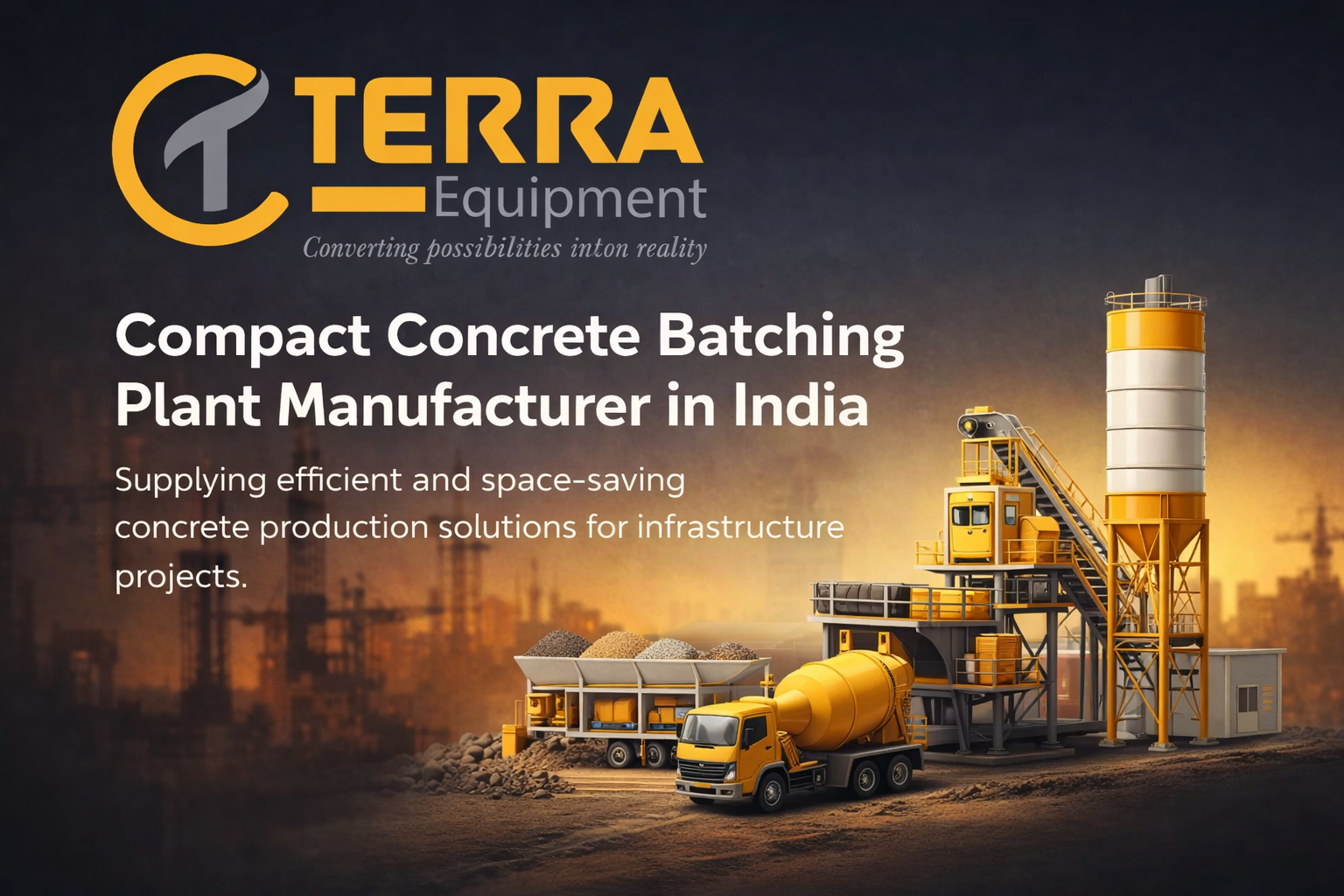
Compact Concrete Batching Plant Manufacturer in India
Concrete production is one of the most critical processes in modern infrastructure development. Large infrastructure projects such as roads, bridges, canals, dams, and commercial buildings require consistent, high-quality concrete to ensure long-term durability and structural stability. To meet these requirements, construction companies increasingly rely on automated concrete batching solutions that deliver precise material proportioning and efficient mixing operations.
A compact concrete batching plant manufacturer in India plays an important role in supplying equipment designed to simplify concrete production while optimizing available space at project sites. Compact batching plants are engineered to provide reliable performance in environments where site space is limited but high production accuracy is essential. These systems combine material storage, weighing, mixing, and discharge processes into an integrated structure that can be installed and operated with minimal civil work.
As construction activity continues to expand across India, demand for efficient batching technology has grown significantly. Compact batching plants allow project teams to produce ready-mix concrete directly at construction sites while maintaining strict control over raw material proportions and overall concrete quality.
Understanding Compact Concrete Batching Plants
A compact concrete batching plant is a specialized construction machine used to produce concrete by accurately combining aggregates, cement, water, and chemical admixtures. Unlike traditional large batching systems that require extensive installation space and supporting infrastructure, compact batching plants are designed with integrated components assembled on a single chassis.
This configuration simplifies transportation, installation, and on-site operation while maintaining the accuracy required for structural concrete production. The equipment integrates aggregate storage bins, weighing systems, mixers, conveyors, and control units into a single structure that can be quickly deployed at construction locations.
Because of their modular design and automated operating features, compact batching plants are widely used in infrastructure projects where consistent concrete quality and operational efficiency are essential.
Key Features of Compact Concrete Batching Plants
Compact batching plants incorporate several engineering features that enhance performance and simplify site operations. These features are designed to support continuous concrete production while ensuring accurate proportioning of raw materials.
Important design features typically include:
These engineering features allow compact batching plants to maintain consistent concrete quality while improving operational efficiency at project locations.
Technical Structure and Working Process
Concrete batching plants follow a systematic process to produce concrete according to specified mix designs. The process begins with the storage of aggregates in separate bins. Cement and additives are stored in dedicated silos or feeding systems, while water is stored in calibrated tanks.
The production cycle generally includes the following stages:
Automated PLC control panels continuously monitor this process, ensuring accurate measurement of raw materials and maintaining consistent mix quality throughout production.
Output Capacity and Model Variations
Compact concrete batching plants are available in multiple capacity configurations to meet the requirements of different construction projects. Production capacity generally depends on the mixer type, plant design, and operational parameters.
Common output capacities include systems capable of producing approximately 20, 25, 30, 45, or 60 cubic meters of concrete per hour. These capacity options allow contractors and project managers to select batching plants based on the scale and demand of their infrastructure projects.
Higher-capacity plants are typically used for large infrastructure developments such as highways, dams, and major construction works, while smaller models are often suitable for commercial buildings, canal lining projects, or medium-scale infrastructure tasks.
Space Efficiency and Installation Advantages
One of the primary advantages of compact batching plants is their ability to operate efficiently within limited site space. Construction projects located in urban areas or confined environments often face logistical challenges related to equipment installation.
Compact batching plants address these challenges through integrated structural designs that combine multiple components into a single assembly. Since the entire plant is mounted on a single chassis, installation becomes significantly easier compared to conventional batching systems.
Many models also provide optional fabricated skid structures that reduce the need for complex civil foundation work. This allows contractors to deploy batching plants quickly and begin production without extensive site preparation.
Automation and Control Systems
Modern compact batching plants incorporate advanced control systems to improve operational reliability and production accuracy. PLC-based control panels enable operators to monitor the entire batching process from a centralized control cabin.
Automation systems perform several important functions, including:
These control features help maintain consistent concrete quality while improving production monitoring and traceability across large construction projects.
Applications in Infrastructure and Construction Projects
Compact batching plants are widely used across multiple infrastructure sectors due to their reliability and operational flexibility. Their ability to deliver accurate concrete mixes makes them suitable for projects that require strict quality control and continuous concrete supply.
Common applications include:
These projects often require consistent concrete production close to the worksite, making compact batching plants an efficient solution for on-site concrete manufacturing.
Growing Demand for Concrete Batching Plants in India
India's rapid infrastructure development has created strong demand for modern construction equipment capable of supporting large-scale projects. Government investments in highways, smart cities, irrigation systems, and industrial zones have significantly increased the need for efficient concrete production systems.
As a result, compact concrete batching plant manufacturers in India play an important role in supporting infrastructure growth. Contractors and engineering firms increasingly prefer automated batching systems that maintain consistent concrete quality while reducing installation complexity and operational downtime.
The ability to transport compact plants easily between project sites further enhances their suitability for infrastructure projects that require mobility and flexible deployment.
Selecting a Reliable Concrete Batching Plant Manufacturer
Choosing the right batching plant manufacturer is an important decision for construction companies involved in long-term infrastructure projects. Equipment reliability, automation capabilities, and technical support all influence operational efficiency and project performance.
When evaluating batching plant suppliers, buyers often consider several key factors:
Selecting a reliable manufacturer helps ensure consistent equipment performance throughout the lifecycle of infrastructure projects.
Future Trends in Concrete Batching Technology
Construction technology continues to evolve as infrastructure projects become larger and more complex. Concrete batching plants are also advancing to meet the changing requirements of modern construction environments.
Recent developments include improved automation systems, enhanced data monitoring capabilities, and energy-efficient mixer technologies. Digital monitoring solutions are increasingly integrated with batching plants to allow remote supervision, performance tracking, and improved operational management.
As the construction sector continues to adopt advanced project management technologies, batching plants will remain a central component in delivering high-quality concrete for infrastructure development.
Frequently Asked Questions
A compact concrete batching plant is a construction machine designed to produce concrete by combining aggregates, cement, water, and admixtures in controlled proportions. The plant integrates storage bins, conveyors, mixers, and control systems into a compact assembly that simplifies installation and operation.
Compact batching plants combine all major components into a single structural assembly, which reduces installation space and transportation requirements. Traditional batching plants typically require larger installation areas and more extensive civil work at project sites.
Compact batching plants are widely used in infrastructure projects such as roads, bridges, canals, dams, and commercial construction. Their design enables efficient concrete production at construction sites where space and logistical constraints are present.
Compact batching plants are available in multiple output capacities ranging from approximately 20 cubic meters per hour to 60 cubic meters per hour. The choice of capacity depends on project size, concrete demand, and operational requirements.
Automated batching plants improve production accuracy by controlling the measurement of aggregates, cement, water, and admixtures through digital load cell systems. This ensures consistent concrete quality and reduces the possibility of mix design errors.